Slash: Not Just a Punctuation Mark Anymore – Lingua Franca
May 6, 2013 § Leave a comment

It’s not news to me that the word “slash” is a commonly used word (yes, the word, not the symbol—as in, “this bookstore slash coffee shop is my new favorite study spot,” or “my plans tomorrow include studying for finals slash watching West Wing reruns slash Facebook-stalking my ex”). My generation’s been using the term with panache for as long as I can remember.
But I’d never thought about the role “slash” plays in our always-evolving lexicon. Unlike the nouns and verbs we add to our vocabularies almost daily (Obamacare, Snapchat, twerk), “slash” is something different: a new conjunction, which means something like “and/or.” Says Anne Curzan at The Chronicle of Higher Education, “slash” is like a “rare-bird sighting in the world of linguistics.” If only we could say the same of “twerk.”
Great article on the Lingua Franca blog—read slash learn.
Slash: Not Just a Punctuation Mark Anymore – Lingua Franca – The Chronicle of Higher Education.
Every language needs its, like, filler words – io9
April 22, 2013 § Leave a comment
We’ve always been advised to, like, avoid using “filler words.” Y’know, words like “um,” “I mean,” “well,” “uh,” and stuff?
Here’s an interesting—but not all that surprising—finding. These words actually do serve a purpose. In a research study, participants were quicker to respond to commands from a computer that did use filler words than from one that didn’t.
To listeners, “uh” indicates that something new, which requires more mental processing on the part of the speaker, is about to be introduced. This helped the study participants put themselves in the right mindset of choosing from the as-yet unfamiliar objects.
They might not be the most elegant utterances to hear, but in some small way, these words carry meaning—and they aid our understanding. I’ve noticed Spanish and English both have their own sets of filler words—and according to the article, so does every other language.
I dunno, I guess that means filler words, like, aren’t so bad after all.

Ed’s Magazine Glossary | Ed2010™
January 16, 2013 § Leave a comment

Ed2010 is a great resource for jobs, education, and news about the publishing industry. Here’s their glossary of words to know if you want to make it in the magazine world. I’ll admit, I didn’t know many of the words on this list—I like acronyms “MEGO” (my eyes glaze over) and “WYSIWYG” (what you see is what you get). Bookmarking this in case I ever need it!
“I had this realization that every individual language does at least one thing better than every other language.”
December 22, 2012 § Leave a comment
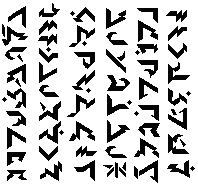
Image via Wikimedia Commons. By the way, it’s Ithkuil for “As our vehicle leaves the ground and plunges over the edge of the cliff toward the valley floor, I ponder whether it is possible that one might allege I am guilty of an act of moral failure, having failed to maintain a proper course along the roadway.”
If I weren’t a writer, I would definitely be a linguist. And as someone who used to make up my own languages as a kid (and then journal in them—no joke), I love reading about stuff like this. Great (but long) read by Joshua Foer, who tells the story of Ithkuil, one of the world’s most “efficient” languages—and its enigmatic creator.
 MARY GABLE