J.K. Rowling wrote a new book. Forensic linguists found it.
July 18, 2013 § Leave a comment
 When I first heard the term “forensic linguistics,” I imagined crime-drama sleuths poring over the jumbled letters of a ransom note.
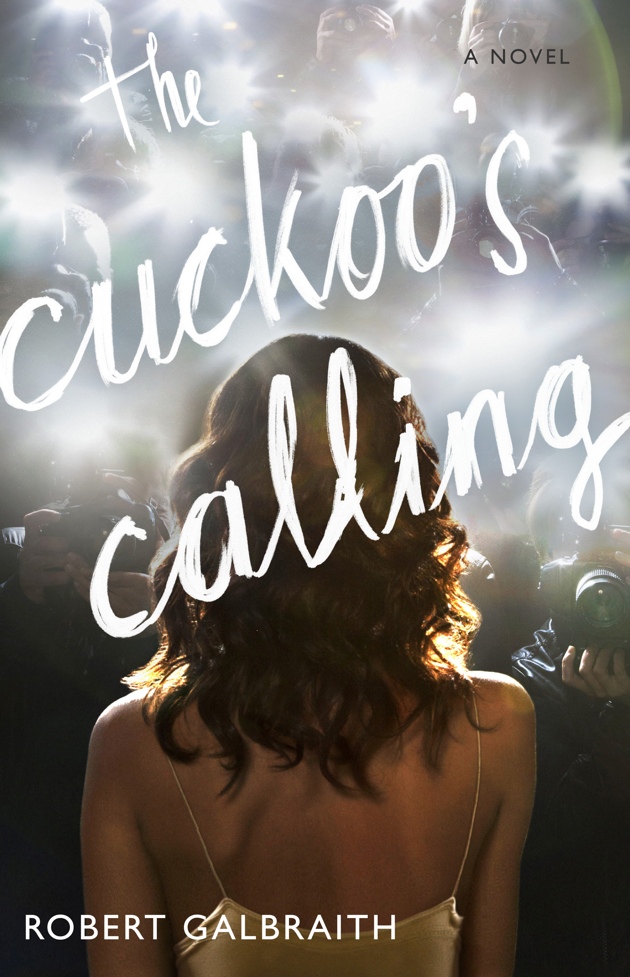
Sometimes, that’s part of their job description. But forensic linguists (also known as ‘stylometrists’) deal with less creepy stuff too, like digging up plagiarism, solving intellectual property disputes, or, this week, outing writer J.K. Rowling as the true author of The Cuckoo’s Calling, a novel written under the pen name Robert Galbraith.
This is huge news for Potter fans. (No surprise that once “Galbraith’s” identity was revealed, the book shot to the top of bestseller lists.) And for Rowling, this is either the end of an attempt to get some unbiased criticism—or a genius PR stunt.
Solving the mystery
But what’s really amazing is how researchers figured it out. After a U.K. Sunday Times writer got an anonymous tip on Twitter, he asked Patrick Juola, a computer science professor at Duquesne and specialist in the subject, to help crack the code.
Juola used a computer program he helped develop to sniff out the most commonly used words in Cuckoo (incidentally, it’s a detective novel). He then compared these to other works of Rowling’s—and to books published by other authors in the same genre.
Similar word-use proportions between two texts suggest—but obviously don’t prove—a single creator. Juola found that the style of The Cuckoo’s Calling was more similar to Rowling’s latest work, The Casual Vacancy, than non-Rowling novels he analyzed.
Turns out, authors wanting to remain nameless can’t just hide by swapping a few words and turns of phrase. What’s most revealing are writers’ uses of things like articles and prepositional phrases. We don’t think to change them because we use them pretty much without thinking.
New dream job?
As a writer who works for many different types of clients, this gives me pause. I like to think I can easily transform my voice and style based on a client’s needs. I’d also like to think that language, especially literature, is somehow immune to such cold analysis.
But I’m also pretty fascinated to see this way language and science can intersect. And I’m interested to see more applications of forensic linguistics in the future. The fact that a text can be reduced to features like word counts and “character 4-grams” doesn’t mean it’s flawed. After all, stylometrists just used it to expose the most accomplished writer in the world.
Read Juola’s explanation of the research and his results on Language Log this week.
What It’s Really Like To Be A Copy Editor | The Awl
December 15, 2012 § Leave a comment
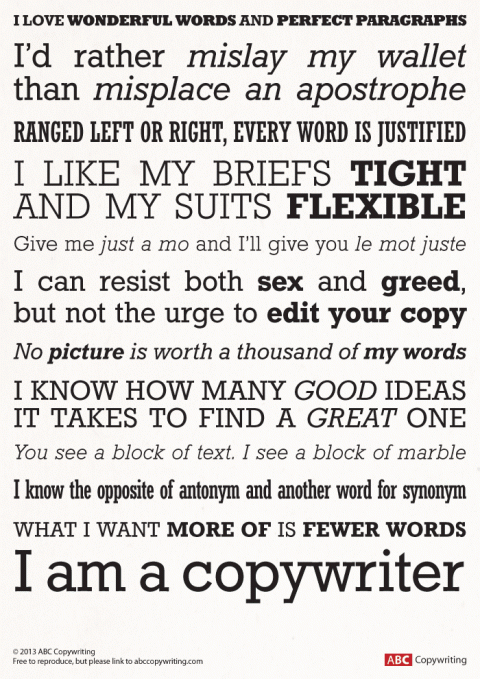
This is wonderful. Copy editors (copyeditors?), you’ll be able to relate.
I never necessarily aspired to be a copy editor. I enjoyed the experience-seriously, your job is to sit and read articles-but when my day-camp counselor asked me what I wanted to be when I grew up, I did not tell her that I hoped one day to correct who-whom mix-ups or determine whether “faucetry” was a real, dictionary-approved word. I told her I wanted to be a princess.
Style guides and scones
September 5, 2012 § 2 Comments
A few times a week, I’ve been camping out at the coffee shop on my block. It’s a nice change from my desk at home (plus, they have the best chocolate-chip cinnamon scones you’ve ever tasted). At my favorite corner in the back (tucked away, sort of, from the noisy cash register and espresso machine) is a little neighborhood book exchange.
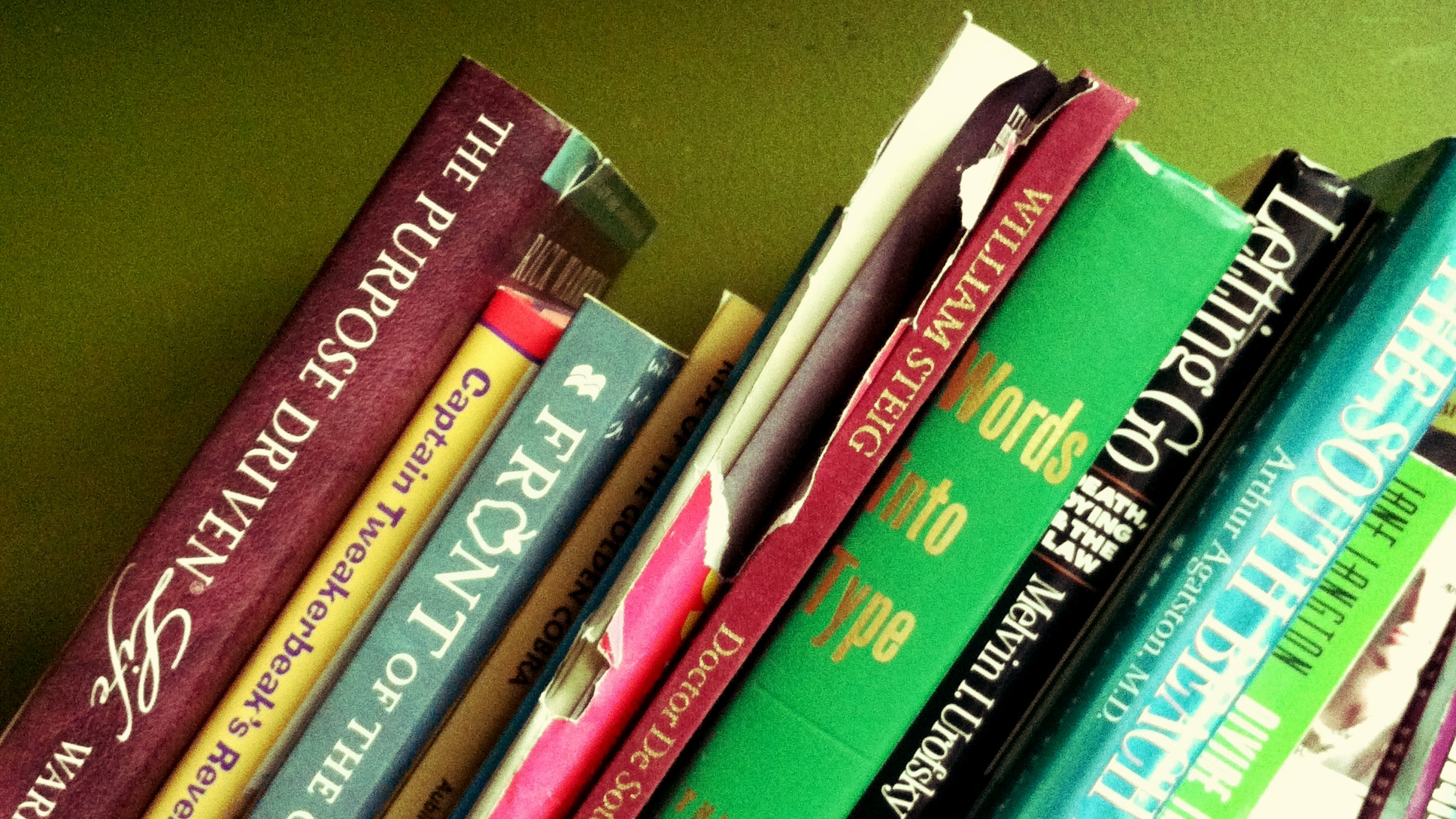
It’s mostly your typical rummage-sale used book fare: think trashy paperbacks, battered coffee-table books on castles and gardening, and how-to guides with titles like Windows 2000 for Dummies. But one book caught my eye. Gold letters on a green spine: Words Into Type.
I’ve always had a thing for old-school style guides. Over the past few years, I’ve collected more than I’ll probably ever need (or use). But just one more can’t hurt, right?
Words Into Type contains the chapters you’d expect: editorial marks, citation styles, grammar and punctuation particulars. But there was one section I’d never seen before: a list of “prepositional idioms.” It reminded me of preposition lists I had to memorize as a student just beginning to learn Spanish. It never occurred to me that a similar list must exist for the English language.
For example, the word “identical” can only be followed, according to the guide, by the preposition “with;” “muse” with “on” or “upon.”
I’m not sure that today’s usage is quite as limited as thebook suggests (it counts “vest-pocket republic” and “like a bolt from the blue”—whatever those mean—among overused expressions). But I’m always happy to add another reference book to my shelf. Or maybe I should have traded it out for one I already own…

Here’s a link to “The Right Preposition” in the Words Into Type e-book.
Not THAT kind of ‘Olympic style’—AP releases Olympics editorial style guide
August 5, 2012 § 2 Comments
(image via http://yfrog.com/4bfw5mj)
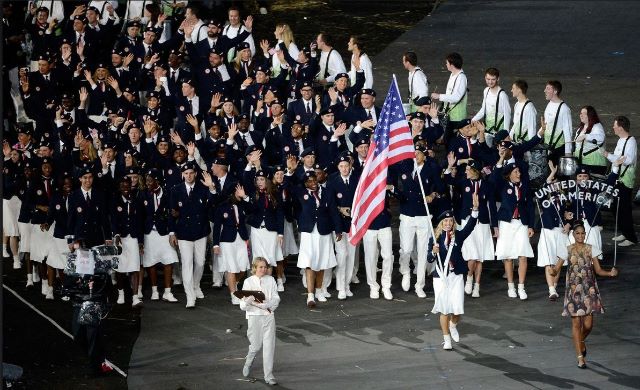
It’s that time of the quadrennium again: time to plunk down in front of the TV, brush up on some world geography, and cheer on athletes for sports you didn’t even know existed (trampoline, anyone?). In honor of the Summer Olympics, here’s the AP’s editorial style guide to the games (not Games, as I learned after reading). Here are a few of the highlights:
Olympics or Olympic Games
Always capitalized. There are Summer Olympics and Winter Olympics, or Summer Games and Winter Games.
Olympics
Noun. Always capitalized.
Olympic
Adjective (without s) and always capitalized: Olympic gold medal, Olympic organizers, Olympic host city, Olympic flame, etc.
Olympiad
A period of four years beginning on Jan. 1 of the Olympic year. Olympiads are numbered consecutively in Roman numerals from the 1896 Athens Games. The XXX Olympiad that includes the London Games began Jan. 1, 2012.
Olympian
Any athlete who has been to the Olympics.
London Games, London Olympics
Capitalized. Also, 2012 Olympics or 2012 Games. London Summer Olympics and London Summer Games.
Games
Capitalized when attached to the host city or year: the London Games and the 2012 Games.
games
Standing alone, lowercase: The games open on July 27.
The year
Always precedes the host city and Olympics: 2012 Olympics, 2012 London Games.
Happy cheering!
 MARY GABLE