You’re probably using Google wrong
August 5, 2013 § Leave a comment
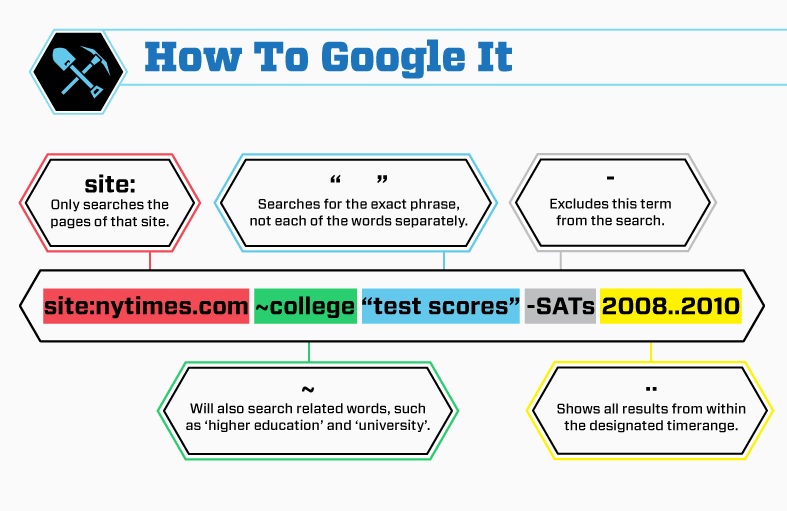
I so wish I’d known these tricks when I was writing my college thesis—but I’m happy to learn them now.
Who knew you could ask Google to search only on a certain site? Or only search for specific types of files? Not this girl. Just in time for back-to-school, here’s an awesome infographic by HackCollege on how to “Get More out of Google.”
How Writers Interact With the World
April 30, 2013 § Leave a comment
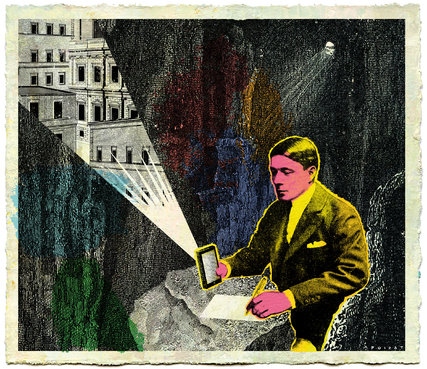
Saint Jerome, the writer as a recluse…may have a lion at his feet, but he lacks other company—and, of course, he has no Wi-Fi.
His condition is distinctly different from that of the modern writer; her room is not only well-lighted and likely lion-free, but also furnishes an Internet connection, through which the world’s tumult pours…
It’s no secret that I love Draft. Not only because it allows me think about writing in new ways—but also because it helps me discover new writers. Writers who write about writing—and who love to think about and explore the same ideas that I do. This week’s piece is no exception.
How Writers Interact With the World – NYTimes.com.
illustration by Chloé Poizat.
Every language needs its, like, filler words – io9
April 22, 2013 § Leave a comment
We’ve always been advised to, like, avoid using “filler words.” Y’know, words like “um,” “I mean,” “well,” “uh,” and stuff?
Here’s an interesting—but not all that surprising—finding. These words actually do serve a purpose. In a research study, participants were quicker to respond to commands from a computer that did use filler words than from one that didn’t.
To listeners, “uh” indicates that something new, which requires more mental processing on the part of the speaker, is about to be introduced. This helped the study participants put themselves in the right mindset of choosing from the as-yet unfamiliar objects.
They might not be the most elegant utterances to hear, but in some small way, these words carry meaning—and they aid our understanding. I’ve noticed Spanish and English both have their own sets of filler words—and according to the article, so does every other language.
I dunno, I guess that means filler words, like, aren’t so bad after all.
Catching up with a copyediting crusader
November 20, 2012 § Leave a comment
A few weeks ago, I had the chance to interview Fred Vultee, a journalism professor and American Copy Editors Society board member. He conducted a study examining readers’ perceptions of edited and unedited news articles. We talked about his research and what it means for the editing craft (spoiler alert: it isn’t going anywhere).
It was awesome to pick Fred’s brain about his research design and methodology (haven’t done that since Wooster), and really exciting to learn from someone helping prove that editors’ jobs really do make a difference.
Portions of my interview with Fred are up on the Dragonfly blog today—check it out.
Closure
March 15, 2012 § 2 Comments

It was a long road to two plastic buttons and a Tootsie Roll.
You could say it started last August, when my advisor and I first sat down to talk about my Independent Study (I.S.), the senior thesis that I had been alternatively looking forward to and dreading since before I had even set foot on Wooster’s campus as a student. You could say the process began a year before that, when in a preparatory course for I.S. I wrote a research proposal which became the framework for my finished product. Yet somehow, I think of my I.S. as beginning my sophomore year, in an English class in which my professor handed out this article on the way languages shape thought.
He passed it out offhandedly, on photocopies distributed at the end of class. It wasn’t required reading, just something for us to take a look at if we had time (which, to most college students, usually means ‘don’t bother’). But I was hooked. The article was about languages with ‘gendered’ nouns (Spanish, French, and German, to name a few), and how these grammatical distinctions change the way we perceive everyday objects. The German word for the English word ‘bridge’ (Brücke) is feminine; its Spanish iteration is the masculine word el puente. So do German speakers tend to attribute more characteristically feminine qualities to their bridges, while Spaniards think of theirs as a bit more manly? The author of the article, and the researcher informing her work, suggested that they do.
I was fascinated. My mind was abuzz with Disney-esque, anthropomorphized images of graceful, womanly bridges and burly masculine keys, roots and prefixes going in and meaning and messages coming out. And while the gendered-noun area of research had already been sufficiently exhausted by that point, it was then that I started to feel like I might find an I.S. topic that I was actually interested in.
Fast-forward a year or so, and I was swimming in the psychological literature investigating the space between language and thought. I found a serious gap in one area—a well-documented theory that was widely known, but had never been tested across languages. I dove in, and soon found myself with the beginnings of a project that was truly my own—no keys or bridges but rather an examination of the ways English- and Spanish-speakers think about others and themselves. My Independent Study was born.
My journey led me to Tupperware parties and Saturday night masses at the local Catholic church, elementary school classrooms and deep in to the writings of thinkers such as Chomsky and Whorf. Week after week I worked, turning in drafts that quickly piled up on my desk, covered in my advisor’s coffee rings and red ink. At times I think I lost sight of what I was even writing about, so focused I became on one detail or another, from the correct interpretation of a particular theory to ensuring that the alignment on my table of contents was just right.
Then—suddenly—it was finished. I was half-expecting some freak computer crash just as I was adding the finishing touches, turning a year of lost sleep into irretrievable oblivion. But there were no spontaneous hard drive collapses, no flash floods or scale-tipping earthquakes as I made my final keystrokes. Finally, there were no more edits to make. It was really over. I saved the 77-page, 20,087-word document (sending a copy to each of my e-mail addresses, just in case), and clicked ‘Print.’
Early the next morning, rain coming down in sheets, I went to the registrar’s office and traded my thesis for a Tootsie Roll, the reward generations of Wooster students have worked so hard to earn.
I savored every bite.
 MARY GABLE