What’s on Your Mind? – NYTimes.com
September 3, 2013 § Leave a comment
Love this article on the writer’s quest to understand the mind. (also love that she’s from Hudson, Ohio, where I lived as a kid.) I think writers, more often than those in other professions, are forced to think about how thoughts work. How ideas form and how they “feel” in the brain. How to lead a reader through an argument as you progress from one point to the next.
Writers don’t do science, of course. But understanding the little quirks and limitations of our minds can help us better understand—and communicate with—others.
Malcolm Gladwell, on writing
December 31, 2012 § 1 Comment

So, Malcolm Gladwell might be a secret spokesman for Big Tobacco. He knows how to tell a story. He was and remains a huge reason I’m doing what I do today. I don’t care how much he makes per speaking engagement—when his next book comes out in 2013, you bet I’ll be buying it—and taking notes.
Gladwell spoke on writing at Yale earlier this year. Here he is:
Gladwell called his entry into journalism “accidental,” having failed to find a job in advertising, but his journalistic interests stem from a passion for “telling stories.” Though his work has garnered widespread acclaim, he said he does not consider himself an original thinker. He does not “generate ideas” for his work, he said, but instead draws ideas from academic papers and finds ways to “make those ideas come alive.”
“I’m not doing the original work,” Gladwell said. “There’s that bird on the back of the elephant that picks off the ticks — I am the bird.”
“I had this realization that every individual language does at least one thing better than every other language.”
December 22, 2012 § Leave a comment

Image via Wikimedia Commons. By the way, it’s Ithkuil for “As our vehicle leaves the ground and plunges over the edge of the cliff toward the valley floor, I ponder whether it is possible that one might allege I am guilty of an act of moral failure, having failed to maintain a proper course along the roadway.”
If I weren’t a writer, I would definitely be a linguist. And as someone who used to make up my own languages as a kid (and then journal in them—no joke), I love reading about stuff like this. Great (but long) read by Joshua Foer, who tells the story of Ithkuil, one of the world’s most “efficient” languages—and its enigmatic creator.
The Benefits of Bilingualism, or, Why Correlation Does Not Imply Causation
April 6, 2012 § Leave a comment
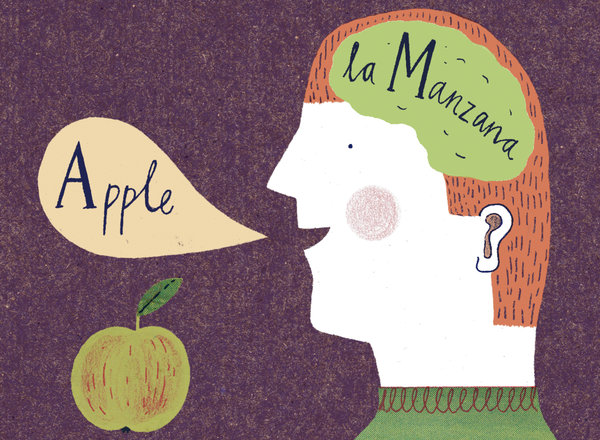
(image via NYTimes.com)
I’ve been reading the New York Times online recently (can you tell?) and was excited to come across this article from a few weeks back on some of the cognitive advantages of bilingualism. I’ve been so immersed in my thesis research for the past year or so that psycholinguists like Bialystok and Kovacs now seem like old friends. The piece serves as a good review of recent research on bilingualism, but I have one quibble: speaking two languages doesn’t “make you smarter,” or “improve” your cognitive skills, as the author claims.
It’s one of those characteristic flaws of popular science writing, that’s been drilled into my head to avoid since Psych 101: reading more into a set of data than is actually there. Assuming that one thing ‘causes’ another; that a test ‘proves’ something to be true; that learning a language ‘makes you smarter.’ To take the Bialystok and Martin experiment, for instance, it’s not as though the researchers taught children to speak a new language, which led to faster card sorting; participants simply had been exposed to two languages from birth, or they hadn’t.
It’s a subtle distinction, but a crucial one: perhaps there was something else that set the bilingual and monolingual children apart. Maybe members of one group were tested mid-morning, and the others after an afternoon snack, when they’d much rather be settling down for a nap than sorting colored cards for a stranger in a lab coat. Maybe other children had had better schooling, more support from their parents to succeed, were hungry or shy or just feeling sick that day. And even if bilingual children did manage to sort cards faster their monolingual daycare-mates, does this really mean that they were smarter?
We don’t know the answers to these questions, and Bialystok and Martin don’t tell us. Yet as seductive as data sets may be in leading us to groundbreaking conclusions, life is far too complex to reduce to mere cause and effect.
 MARY GABLE