19 Emotions For Which English Has No Words
May 15, 2013 § Leave a comment
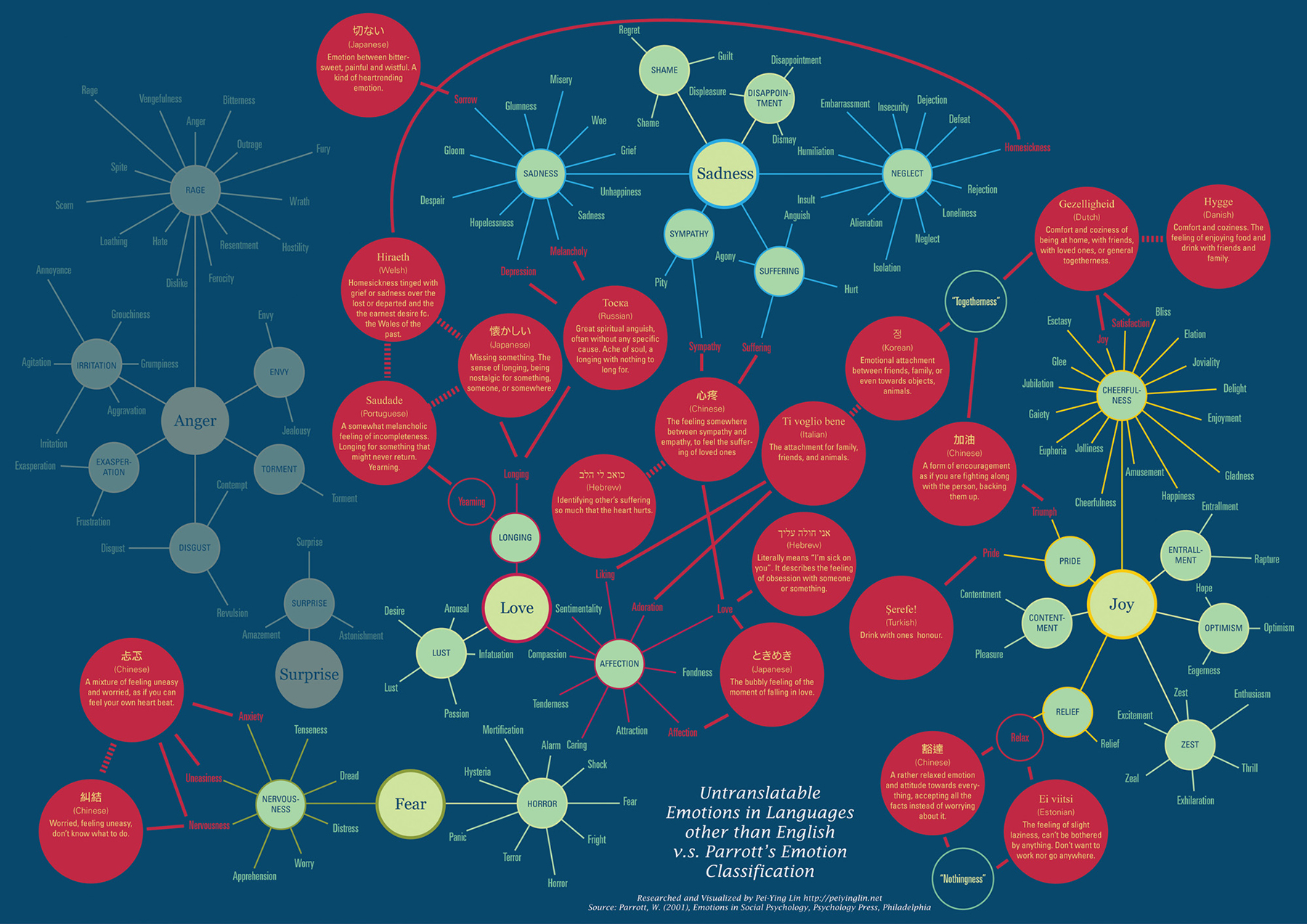
I’ve long been interested in the limitations of language—and the loopholes offered by learning the words of another. Awesome infographic by Pei-Ying Lin via FastCompany (click to make it big).
Also, file under “why hadn’t this been invented yet”: The Emotionary. It’s a list of emotions for which English (until now) has no words. See vindexance (“the immediate desire to redeem oneself upon realizing what you should have said or done moments after it is too late”) and epiphannaise (“the moment one realizes aioli and mayonnaise are exactly the same thing”).
Users can submit new words for once-inexplicable feelings. Personally, I’m looking forward to the “words most felt” page (coming soon!).
Slash: Not Just a Punctuation Mark Anymore – Lingua Franca
May 6, 2013 § Leave a comment

It’s not news to me that the word “slash” is a commonly used word (yes, the word, not the symbol—as in, “this bookstore slash coffee shop is my new favorite study spot,” or “my plans tomorrow include studying for finals slash watching West Wing reruns slash Facebook-stalking my ex”). My generation’s been using the term with panache for as long as I can remember.
But I’d never thought about the role “slash” plays in our always-evolving lexicon. Unlike the nouns and verbs we add to our vocabularies almost daily (Obamacare, Snapchat, twerk), “slash” is something different: a new conjunction, which means something like “and/or.” Says Anne Curzan at The Chronicle of Higher Education, “slash” is like a “rare-bird sighting in the world of linguistics.” If only we could say the same of “twerk.”
Great article on the Lingua Franca blog—read slash learn.
Slash: Not Just a Punctuation Mark Anymore – Lingua Franca – The Chronicle of Higher Education.
Every language needs its, like, filler words – io9
April 22, 2013 § Leave a comment
We’ve always been advised to, like, avoid using “filler words.” Y’know, words like “um,” “I mean,” “well,” “uh,” and stuff?
Here’s an interesting—but not all that surprising—finding. These words actually do serve a purpose. In a research study, participants were quicker to respond to commands from a computer that did use filler words than from one that didn’t.
To listeners, “uh” indicates that something new, which requires more mental processing on the part of the speaker, is about to be introduced. This helped the study participants put themselves in the right mindset of choosing from the as-yet unfamiliar objects.
They might not be the most elegant utterances to hear, but in some small way, these words carry meaning—and they aid our understanding. I’ve noticed Spanish and English both have their own sets of filler words—and according to the article, so does every other language.
I dunno, I guess that means filler words, like, aren’t so bad after all.
The Curious Incidence of Dogs in Publishing – Slate Magazine
April 15, 2013 § Leave a comment
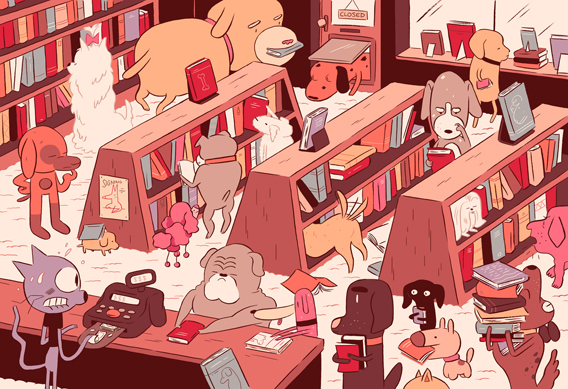
Illustration by Luke Pearson for Slate
Everybody knows that the Internet belongs to cats. Books, conversely, have typically been the domain of dogs. (Think Old Yeller, The Art of Racing in the Rain, Marley & Me.) But why’s that the case?
In a surprisingly well-researched, so-serious-it’s-hilarious account, Slate’s Daniel Engber investigates.
Why are dogs popular in books, and cats popular on the Internet? – Slate Magazine.
THIS IS AWESOME: Times Haiku
April 8, 2013 § Leave a comment
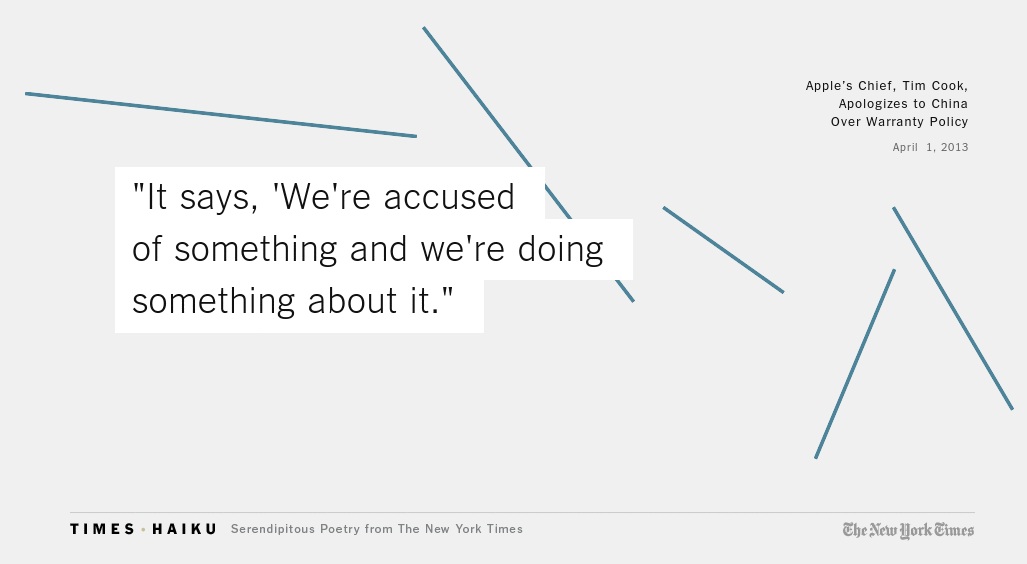
The news slingers at the New York Times have gotten into the poetry business. But not on purpose.
Here’s how “serendipitous poetry” works: an algorithm scans recently published Times articles for sentences that fit a haiku’s requisite 5-7-5 syllable scheme. The machine spits out some true verse—and some duds. Curators choose the best ones, and publish them on the newly created Times Haiku blog.
The insta-poems are styled as images rather than text, so they retain their structure even when they’re shared. Best of all, click on a haiku of interest, and you’re transported to the Times article from which it originates. Pure highbrow genius, for the Age of Tumblr.
 MARY GABLE