Why ‘explainers’ matter
April 8, 2014 § Leave a comment
Last week, the Intergovernmental Panel on Climate Change (IPCC) released Part 2 of its report on global climate change (Part 1 came out in September 2013). The technical summary alone is 76 pages long—fortunately, it’s launched plenty of helpful explainer articles. I recently came across one bit of coverage, in response to Part 1’s release, that piqued my interest.
Greg Johnson summarized the report in a series of 19 illustrated haiku. I’m entranced by these little images, not just for their humbling messages (Forty years from now/children will live in a world/shaped by our choices.), but also for their communicative power.
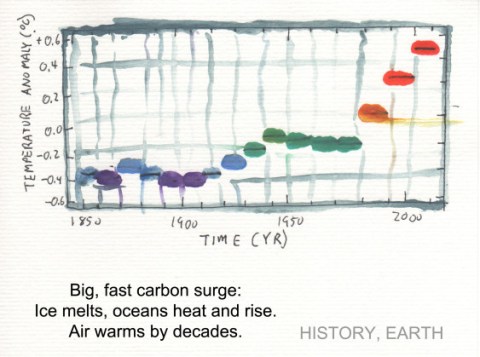
Today, information no longer belongs to the privileged few. Instead, we have the opposite problem: there’s more information out there than we can reasonably consume. We need the ‘explainers,’ people who can sort through the hard data and interpret crucial information for the rest of us.
Whether explaining how to adapt to a warming planet, apply for health coverage, or understand privacy online, this work of translation is more important than ever. Johnson’s haiku excel at this, but they’re just one example (think infographics, ‘listicles,’ or anything else that makes text easier to digest).
While these new ways of presenting information have been much maligned, Johnson’s work reminds me they can also be an incredibly effective way to communicate.
There’s no use calling it ‘wrong’ when there’s this much at stake.
Spanish, and English: Lenguas cambiantes y múltiples
October 27, 2013 § Leave a comment

Image by Raquel Marín via El País
I read a wonderful essay yesterday in El País (an international Spanish-language newspaper, headquartered in Spain). The sixth International Conference of the Spanish Language just concluded in Panama, a triennial meeting with the purpose of examining the state of the Spanish language. No equivalent of this group exists for English speakers, as far as I know: the closest cousin I can think of would be the hoopla that follows the publication of a new Associated Press Stylebook or the OED’s release of words added to the dictionary that year.
The main difference that strikes me between English- and Spanish-speaking word people is that Spanish-speakers aren’t quite the snobbish, stubborn nitpickers we are. Rather than shoving personal preferences about the serial comma or the right way to write the word “website” down one another’s throats, attendees and members of the Instituto Cervantes, which organizes the conference, seem to celebrate Spanish in all its difference and diversity.
Sergio Ramirez, a Nicaraguan writer who gave the CILE’s inaugural address, illuminates just this point. For much of its history, Spanish has been the language of poverty and oppression; of frontier-crossing and culture-blending. Of course the language spoken in Bogotá doesn’t sound like that spoken in Madrid. These differences are something worth celebrating, not stifling.
As writers, editors, scholars, and general English-language obsessives, I think there’s a lot we can learn from our Spanish-speaking counterparts. Here are translations of a few of my favorite passages of Ramirez’ essay, excerpted from his CILE speech.
Soy un escritor de una lengua vasta, cambiante y múltiple, sin fronteras ni compartimientos, que en lugar de recogerse sobre sí misma se expande cada día, haciéndose más rica en la medida en que camina territorios, emigra, muta, se viste y de desviste, se mezcla, gana lo que puede otros idiomas, se aposenta, se queda, reemprende viaje y sigue andando, lengua caminante, revoltosa y entrometida, sorpresiva, maleable. Puedo volar toda una noche, de Managua a Buenos Aires, o de la ciudad de México a Los Ángeles, y siempre me estarán oyendo en mi español centroamericano.
I am a writer of a language that is vast, changing, and numerous; without borders or boxes; that, rather than gathering up around itself, expands each day, making itself ever richer as it crosses territories, migrates, mutates, covers and uncovers itself, mixes, takes what it can from other languages, takes root and remains, then resumes the journey and continues walking; a moving tongue, rebellious and meddling, unexpected, malleable. I can fly through the night, from Managua to Buenos Aires, or from Mexico City to Los Angeles, and all along I will hear the Spanish of Central America.
Cuando en América hablamos acerca de la identidad compartida, nuestro punto de partida, y de referencia común, es la lengua. No somos una identidad étnica, no somos una multitud homogénea, no somos una raza, somos muchas razas. La diversidad es lo que hace la identidad. Tendremos identidad mientras la busquemos y queramos encontrarnos en el otro. Pero somos una lengua, que tampoco es homogénea. La lengua desde la que vengo, y hacia la que voy, y que mientras se halla en movimiento, me lleva consigo de uno a otro territorio, territorios reales o territorios verbales.
When in the Americas we talk of a shared identity, our point of departure, our shared reference, is language. We are not one ethnic identity, nor a homogenous multitude; we are not one race, we are many races. Diversity is what makes our identity. We gain identity as we search for it, and as we seek to find it in others. But we are a single language, which is not homogeneous either. The language from which I come, and toward which I go, and that is moving all the while, carries me with it from one land to another, lands both real and verbal.
Quienes la hablan y quienes la escriben son protagonistas de esa invasión verbal que cada vez más tendrá consecuencias culturales. Consecuencias de dos vías, por supuesto, porque cuando las aguas de un idioma entran en las de otro, se produce siempre un fenómeno de mutuo enriquecimiento.
La lengua que gana nuevos códigos cerca del lenguaje digital, de los nuevos paradigmas de la comunicación, de los libros electrónicos, de las infinitas bibliotecas virtuales que estuvieron desde antes en la imaginación de Borges, y que gana modernidad mientras se adentra en el siglo veintiuno.
El Gran Lengua seguirá siendo el vocero de la tribu. El que tiene el don de la palabra y representa así a los que no tienen voz. El que alza la voz, es él mismo la lengua, la encarna, y se encarna en ella. Guarda y publica la memoria de las ocurrencias del pasado, inventa, imagina, interpreta, recrea, explica, y seduce con las palabras.
¿A qué otra cosa mejor puede aspirar un escritor, sino a ser lengua de una tribu tan variada y tan vasta?
Those who speak and those who write are the protagonists of this verbal invasion of ever-greater cultural effects. Effects in both directions, of course; because when the waters of one language enter those of another, the result is always an enrichment of each.
A language that takes on the new terms of digital technology, of new communication paradigms, of e-books, of the infinite virtual libraries that before lived only in the imagination of Borges, and that gains modernity as it enters the twenty-first century.
The Great Language will remain the voice of the tribe. Those with the gift of words, therefore, represent those without a voice. He that raises his voice, is language himself; he brings it to life, and comes to life within it. He protects and spreads the memory of what has gone before, and invents, imagines, interprets, recreates, explains and seduces with his words.
What else could a writer hope for, than to be the language of a tribe so varied and vast?
What’s on Your Mind? – NYTimes.com
September 3, 2013 § Leave a comment
Love this article on the writer’s quest to understand the mind. (also love that she’s from Hudson, Ohio, where I lived as a kid.) I think writers, more often than those in other professions, are forced to think about how thoughts work. How ideas form and how they “feel” in the brain. How to lead a reader through an argument as you progress from one point to the next.
Writers don’t do science, of course. But understanding the little quirks and limitations of our minds can help us better understand—and communicate with—others.
Why emoticons & emoji are good news for English (well, maybe)
August 27, 2013 § Leave a comment
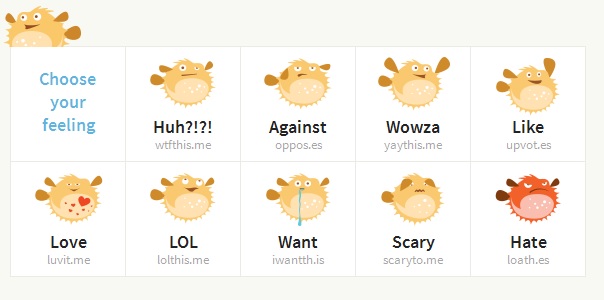 This article, published on Wired last week, makes me beyond excited. At first, I thought “The ‘Mood Graph’: How Our Emotions Are Taking Over the Web” was going to be another one of those “social media is rendering us incapable of human interaction/turning us into unfeeling device-addicted automatons/ruining our lives/etc.” pieces.
Instead, author Evan Selinger (a Fellow at the Institute for Ethics and Emerging Technology) takes a totally different stance. His argument: The written word, whether it appears on a postcard or in a tweet, is already a step removed from spoken communication. Whenever we write, we’re essentially translating our thoughts into the words and phrases available to us. (We do this when we speak, too, of course—but in writing, we usually strive to be more brief and linear than in casual speech.)
So what if digital communication’s latest little embellishments—emoticons, emoji, and the newly available Bitly for Feelings—could actually help us understand each other’s written musings better? Personally, I’ve come to think of these as a kind of punctuation, adding meaning to otherwise ambiguous statements.
Says Selinger, “How many times have you heard, for example, people observe (or console others) that ‘Oh, well, you can never really read tone in email?’”
Yes, forcing users to choose from a drop-down menu of a few dozen grinning and grimacing smileys might limit or simplify the ideas we can express. But wait, doesn’t language do the exact same thing? It’s well-known that there are many emotions for which English has no words.
Selinger explores the social and political implications of confessing our emotions to a blinking status bar. (There’s no doubt a company like Facebook will use its growing “mood data” to its advantage.) This is the first I’ve heard a writer frame emotional (pictorial?) communication this way. But I have a feeling it won’t be the last.
As sharing new aspects of our lives becomes more commonplace, I’ll be interested to see how these add-ons to our language shape and inform the way we communicate.
J.K. Rowling wrote a new book. Forensic linguists found it.
July 18, 2013 § Leave a comment
 When I first heard the term “forensic linguistics,” I imagined crime-drama sleuths poring over the jumbled letters of a ransom note.
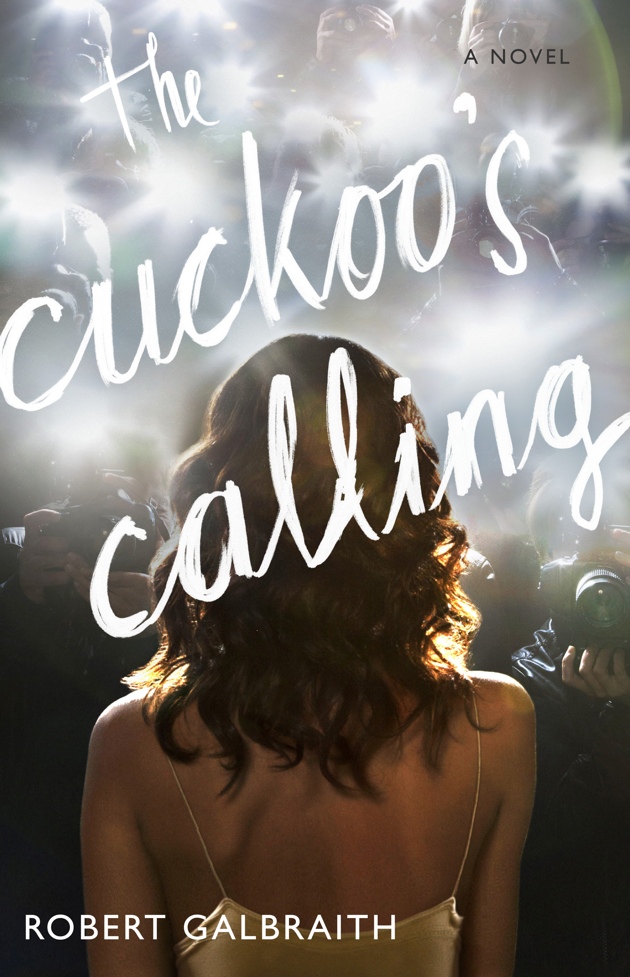
Sometimes, that’s part of their job description. But forensic linguists (also known as ‘stylometrists’) deal with less creepy stuff too, like digging up plagiarism, solving intellectual property disputes, or, this week, outing writer J.K. Rowling as the true author of The Cuckoo’s Calling, a novel written under the pen name Robert Galbraith.
This is huge news for Potter fans. (No surprise that once “Galbraith’s” identity was revealed, the book shot to the top of bestseller lists.) And for Rowling, this is either the end of an attempt to get some unbiased criticism—or a genius PR stunt.
Solving the mystery
But what’s really amazing is how researchers figured it out. After a U.K. Sunday Times writer got an anonymous tip on Twitter, he asked Patrick Juola, a computer science professor at Duquesne and specialist in the subject, to help crack the code.
Juola used a computer program he helped develop to sniff out the most commonly used words in Cuckoo (incidentally, it’s a detective novel). He then compared these to other works of Rowling’s—and to books published by other authors in the same genre.
Similar word-use proportions between two texts suggest—but obviously don’t prove—a single creator. Juola found that the style of The Cuckoo’s Calling was more similar to Rowling’s latest work, The Casual Vacancy, than non-Rowling novels he analyzed.
Turns out, authors wanting to remain nameless can’t just hide by swapping a few words and turns of phrase. What’s most revealing are writers’ uses of things like articles and prepositional phrases. We don’t think to change them because we use them pretty much without thinking.
New dream job?
As a writer who works for many different types of clients, this gives me pause. I like to think I can easily transform my voice and style based on a client’s needs. I’d also like to think that language, especially literature, is somehow immune to such cold analysis.
But I’m also pretty fascinated to see this way language and science can intersect. And I’m interested to see more applications of forensic linguistics in the future. The fact that a text can be reduced to features like word counts and “character 4-grams” doesn’t mean it’s flawed. After all, stylometrists just used it to expose the most accomplished writer in the world.
Read Juola’s explanation of the research and his results on Language Log this week.
 MARY GABLE