Every language needs its, like, filler words – io9
April 22, 2013 § Leave a comment
We’ve always been advised to, like, avoid using “filler words.” Y’know, words like “um,” “I mean,” “well,” “uh,” and stuff?
Here’s an interesting—but not all that surprising—finding. These words actually do serve a purpose. In a research study, participants were quicker to respond to commands from a computer that did use filler words than from one that didn’t.
To listeners, “uh” indicates that something new, which requires more mental processing on the part of the speaker, is about to be introduced. This helped the study participants put themselves in the right mindset of choosing from the as-yet unfamiliar objects.
They might not be the most elegant utterances to hear, but in some small way, these words carry meaning—and they aid our understanding. I’ve noticed Spanish and English both have their own sets of filler words—and according to the article, so does every other language.
I dunno, I guess that means filler words, like, aren’t so bad after all.
Must-read writing on the Boston Marathon bombings
April 16, 2013 § Leave a comment
In the wake of tragedy, I find comfort in the work of thoughtful, skilled writers, those who somehow manage to put to paper the words the rest of us are still grappling to find. For me, writers’ words have always brought some sense to senselessness like this—or at least make me feel a little less alone.
Below is a selection of great articles I’ve read today in the aftermath of the attack on Boston.
- The People Who Watch Marathons, Erin Gloria Ryan, Jezebel.
- The Boston Marathon: All My Tears, All My Love, Dave Zirin, The Nation.
- Homemade Marathons, Susan Orlean, The New Yorker.
- The Marathon, Nathan Savin Scott, Thought Catalog.
- “If you are scared, they win. If you refuse to be scared, they lose.” Interview between Ezra Klein and Bruce Schneier, Wonkblog. Schneier actually published an article of his own in the Atlantic, but for me, this interview is even more crisp and powerful.
The Curious Incidence of Dogs in Publishing – Slate Magazine
April 15, 2013 § Leave a comment
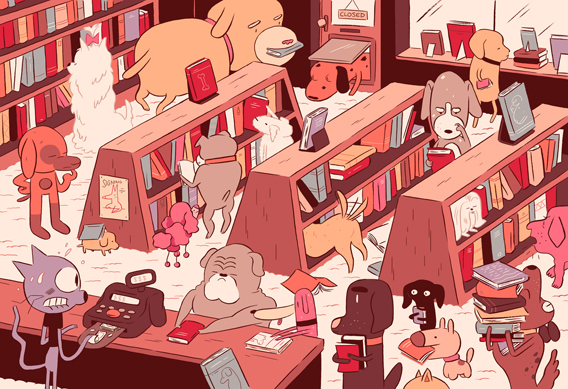
Illustration by Luke Pearson for Slate
Everybody knows that the Internet belongs to cats. Books, conversely, have typically been the domain of dogs. (Think Old Yeller, The Art of Racing in the Rain, Marley & Me.) But why’s that the case?
In a surprisingly well-researched, so-serious-it’s-hilarious account, Slate’s Daniel Engber investigates.
Why are dogs popular in books, and cats popular on the Internet? – Slate Magazine.
THIS IS AWESOME: Times Haiku
April 8, 2013 § Leave a comment
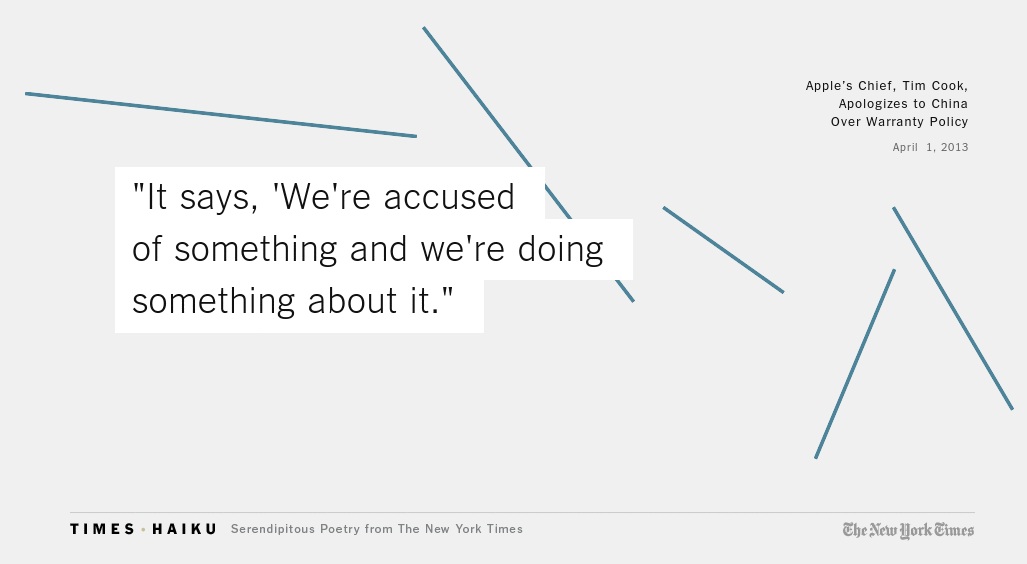
The news slingers at the New York Times have gotten into the poetry business. But not on purpose.
Here’s how “serendipitous poetry” works: an algorithm scans recently published Times articles for sentences that fit a haiku’s requisite 5-7-5 syllable scheme. The machine spits out some true verse—and some duds. Curators choose the best ones, and publish them on the newly created Times Haiku blog.
The insta-poems are styled as images rather than text, so they retain their structure even when they’re shared. Best of all, click on a haiku of interest, and you’re transported to the Times article from which it originates. Pure highbrow genius, for the Age of Tumblr.
Mad Dash: How to Use the Dash in Writing – NYTimes.com
April 1, 2013 § Leave a comment

Image via NYTimes.com
Love Draft, love Ben Yagoda, love this post. Plus—I love the em dash.
Like hitting the right combination of buttons in a computer game, typing two hyphens on the keyboard — and thereby making a dash — can give your prose a burst of energy, as if by magic.
 MARY GABLE