You’re probably using Google wrong
August 5, 2013 § Leave a comment
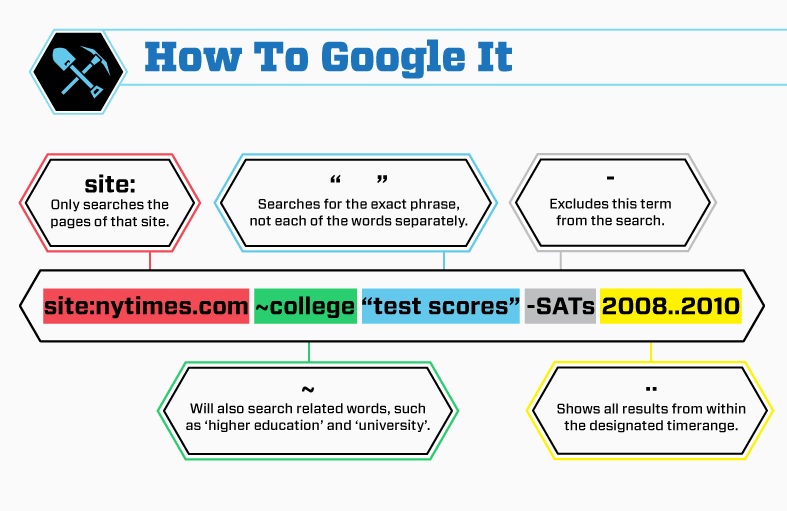
I so wish I’d known these tricks when I was writing my college thesis—but I’m happy to learn them now.
Who knew you could ask Google to search only on a certain site? Or only search for specific types of files? Not this girl. Just in time for back-to-school, here’s an awesome infographic by HackCollege on how to “Get More out of Google.”
Healthy writer = productive writer
July 29, 2013 § Leave a comment
Working from home comes with tons of awesome perks. (Conference calls in pajamas being chief among them.) And while I love the flexibility and freedom it offers, telecommuting does have one downside:
When you don’t ever have to leave home, it’s hard to make yourself get up and move.
I can’t deny that I’m more focused, productive, and even more creative on days I manage to squeeze a workout in. And I’ve tried to build early-morning runs and weekly yoga classes into my daily routine. But sometimes it’s easier to just stay glued to the computer (or snoozing in bed) instead of getting moving.
So I’ve learned to take breaks. Even taking just 5 minutes to stretch and recharge helps.
I didn’t arrive at this conclusion totally on my own, though—I’ve stolen some tricks from some writers who have been there. Here are some resources I’ve found that help writers focus on writing (not to mention become healthier all-around):
- Sit up straight. This is so simple, yet so hard to actually do (for me, at least). But Sedentary Death Syndrome is just about the most insidious way to die I’ve ever heard, so I’m not giving up yet.
- Stretch your most important writing muscles—your fingers! I literally have Diana’s “six simple stretches” printed out and posted above my desk. My favorite is the rubber band stretch—great for relieving stiff hands. Ahhhhhh…
- Clear your head. Daphne Gray-Grant’s newsletter and blog offer practical, no-nonsense writing advice week after week. This list includes some great ways to quiet your mind and quash anxiety—and they have nothing to do with writing. Go watch a movie or take a walk! I’m always surprised by how my productivity level seems to reset after a little break.
- Eat smart. For me, taking a break from work often means going in search of a snack. Nobody needs a junk food-free home more than a work-from-home writer. Keep fresh, healthy foods on hand, and you’ll remain energized and focused throughout the day.
When I first tried these strategies, it all felt like a chore. (Kind of like exercise itself: you know it’s good for you, but sometimes you just. don’t. want. to.) Or I felt like I was slacking off for doing something other than work.
Now, these have pretty much become habit (okay, fine, I’m still working on the sitting up straight thing). And there’s no doubt my writing has benefited. I guess I haven’t been slacking after all.
Got more secrets to staying healthy and focused while working from home? I’d love to hear them. Let me know in the comments.
J.K. Rowling wrote a new book. Forensic linguists found it.
July 18, 2013 § Leave a comment
 When I first heard the term “forensic linguistics,” I imagined crime-drama sleuths poring over the jumbled letters of a ransom note.
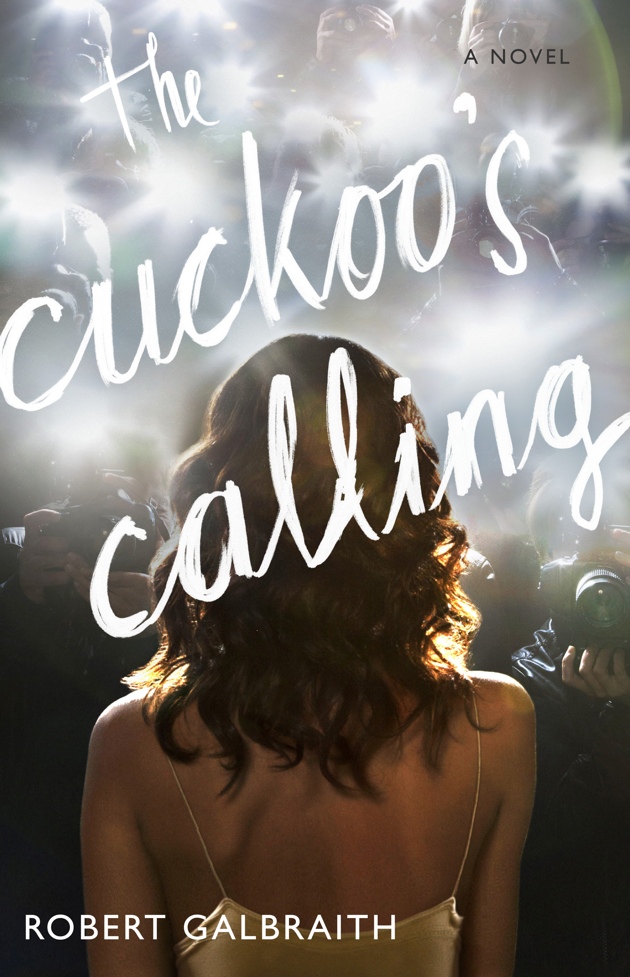
Sometimes, that’s part of their job description. But forensic linguists (also known as ‘stylometrists’) deal with less creepy stuff too, like digging up plagiarism, solving intellectual property disputes, or, this week, outing writer J.K. Rowling as the true author of The Cuckoo’s Calling, a novel written under the pen name Robert Galbraith.
This is huge news for Potter fans. (No surprise that once “Galbraith’s” identity was revealed, the book shot to the top of bestseller lists.) And for Rowling, this is either the end of an attempt to get some unbiased criticism—or a genius PR stunt.
Solving the mystery
But what’s really amazing is how researchers figured it out. After a U.K. Sunday Times writer got an anonymous tip on Twitter, he asked Patrick Juola, a computer science professor at Duquesne and specialist in the subject, to help crack the code.
Juola used a computer program he helped develop to sniff out the most commonly used words in Cuckoo (incidentally, it’s a detective novel). He then compared these to other works of Rowling’s—and to books published by other authors in the same genre.
Similar word-use proportions between two texts suggest—but obviously don’t prove—a single creator. Juola found that the style of The Cuckoo’s Calling was more similar to Rowling’s latest work, The Casual Vacancy, than non-Rowling novels he analyzed.
Turns out, authors wanting to remain nameless can’t just hide by swapping a few words and turns of phrase. What’s most revealing are writers’ uses of things like articles and prepositional phrases. We don’t think to change them because we use them pretty much without thinking.
New dream job?
As a writer who works for many different types of clients, this gives me pause. I like to think I can easily transform my voice and style based on a client’s needs. I’d also like to think that language, especially literature, is somehow immune to such cold analysis.
But I’m also pretty fascinated to see this way language and science can intersect. And I’m interested to see more applications of forensic linguistics in the future. The fact that a text can be reduced to features like word counts and “character 4-grams” doesn’t mean it’s flawed. After all, stylometrists just used it to expose the most accomplished writer in the world.
Read Juola’s explanation of the research and his results on Language Log this week.
Follow me on Feedly (it’s not so bad!)
June 26, 2013 § Leave a comment
 Less than a week from today, Google Reader will be no more. In preparation, I’ve migrated all of my feeds over to Feedly. (Here’s how to do that.) While it’s not quite as intuitive as Reader, in my opinion, it offers a good user experience and some nice discovery options. (Layout feature you don’t like? You can probably change it in your preferences.)
And since it doesn’t seem like Feedly will be abandoning us anytime soon, I’ve added a “Follow on Feedly” button to See Mary Write. That means you can follow me right along with your other favorite feeds (just what you wanted, right?).

Want a button of your own? Get one here.
Next week we enter the post-Reader world. I’ll see you there.
Tice’s advice for new writers
June 17, 2013 § 1 Comment
I’ve been subscribed for a few weeks to Carol Tice’s Make a Living Writing newsletter. While I’m not necessarily looking for freelance work, Tice sends smart, pithy daily tips on building client relationships, growing confidence, and creating an online presence. (Last week, she hosted a “link party,” where followers could share—and vote on—favorite writing-related links.)
I really liked a post Tice published last week, on “The Advice I Wish I’d Had as New Freelance Writer.” Her advice is funny and reassuring: “I wish someone would have told me right off that no one cares if you learned to write under a freeway overpass or at Columbia. If you can get the story and tell it so we want to read it, you’re in.”
Now that’s advice I can use. Tice also recommends “diving in, and being scared later” and “developing niche expertise.”
I’m happy to learn from Tice’s more than 20 years of freelance know-how. (Her website, by the way, is a gold mine of resources for would-be writers.) Keep those emails coming!
 MARY GABLE