Take that, English majors.
April 24, 2012 § Leave a comment
I entered my first writing competition a few weeks ago, submitting a personal essay I wrote for a class earlier this semester. I figured it might be a long shot, but—I took second place! (And it came with a cash prize, so it still feels like a win to me.) I’m going to a reading later this week for some of the contest winners. The essay, titled “Manzanilla,” (as in the chamomile tea, not the wine) is available here or on my Academic Writing page. Enjoy!
The Benefits of Bilingualism, or, Why Correlation Does Not Imply Causation
April 6, 2012 § Leave a comment
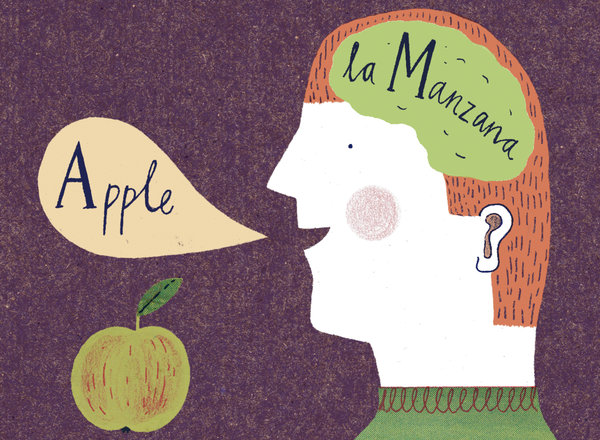
(image via NYTimes.com)
I’ve been reading the New York Times online recently (can you tell?) and was excited to come across this article from a few weeks back on some of the cognitive advantages of bilingualism. I’ve been so immersed in my thesis research for the past year or so that psycholinguists like Bialystok and Kovacs now seem like old friends. The piece serves as a good review of recent research on bilingualism, but I have one quibble: speaking two languages doesn’t “make you smarter,” or “improve” your cognitive skills, as the author claims.
It’s one of those characteristic flaws of popular science writing, that’s been drilled into my head to avoid since Psych 101: reading more into a set of data than is actually there. Assuming that one thing ‘causes’ another; that a test ‘proves’ something to be true; that learning a language ‘makes you smarter.’ To take the Bialystok and Martin experiment, for instance, it’s not as though the researchers taught children to speak a new language, which led to faster card sorting; participants simply had been exposed to two languages from birth, or they hadn’t.
It’s a subtle distinction, but a crucial one: perhaps there was something else that set the bilingual and monolingual children apart. Maybe members of one group were tested mid-morning, and the others after an afternoon snack, when they’d much rather be settling down for a nap than sorting colored cards for a stranger in a lab coat. Maybe other children had had better schooling, more support from their parents to succeed, were hungry or shy or just feeling sick that day. And even if bilingual children did manage to sort cards faster their monolingual daycare-mates, does this really mean that they were smarter?
We don’t know the answers to these questions, and Bialystok and Martin don’t tell us. Yet as seductive as data sets may be in leading us to groundbreaking conclusions, life is far too complex to reduce to mere cause and effect.
I Was a Cookbook Ghostwriter – NYTimes.com
March 23, 2012 § Leave a comment

(image via NYTimes.com)
“In his first assignment, a writer I know had to produce a book on Japanese cuisine based on two interviews with a chef who spoke no English.
“That,” he said, “was the moment that I realized cookbooks were not authoritative.”
“Write up something about all the kinds of chiles,” one Mexican-American chef demanded of me, providing no further details. “There should be a really solid guide to poultry,” a barbecue maven prescribed for his own forthcoming book. (After much stalling, he sent the writer a link to the Wikipedia page for “chicken.”)…”
Interesting article from The New York Times on the thankless world of ghostwriting for celebrity cookbooks. While it’s no surprise that chefs don’t actually write their books’ introductions or even the details of their recipes, I think I was one of those readers who “quaintly” believed that cooks at least taste the recipes they’re given credit for. The article apparently provoked some strongly-worded tweets from a few of the chefs mentioned–author Julia Moskin clarified her statements on Monday with a follow-up piece.
Closure
March 15, 2012 § 2 Comments

It was a long road to two plastic buttons and a Tootsie Roll.
You could say it started last August, when my advisor and I first sat down to talk about my Independent Study (I.S.), the senior thesis that I had been alternatively looking forward to and dreading since before I had even set foot on Wooster’s campus as a student. You could say the process began a year before that, when in a preparatory course for I.S. I wrote a research proposal which became the framework for my finished product. Yet somehow, I think of my I.S. as beginning my sophomore year, in an English class in which my professor handed out this article on the way languages shape thought.
He passed it out offhandedly, on photocopies distributed at the end of class. It wasn’t required reading, just something for us to take a look at if we had time (which, to most college students, usually means ‘don’t bother’). But I was hooked. The article was about languages with ‘gendered’ nouns (Spanish, French, and German, to name a few), and how these grammatical distinctions change the way we perceive everyday objects. The German word for the English word ‘bridge’ (Brücke) is feminine; its Spanish iteration is the masculine word el puente. So do German speakers tend to attribute more characteristically feminine qualities to their bridges, while Spaniards think of theirs as a bit more manly? The author of the article, and the researcher informing her work, suggested that they do.
I was fascinated. My mind was abuzz with Disney-esque, anthropomorphized images of graceful, womanly bridges and burly masculine keys, roots and prefixes going in and meaning and messages coming out. And while the gendered-noun area of research had already been sufficiently exhausted by that point, it was then that I started to feel like I might find an I.S. topic that I was actually interested in.
Fast-forward a year or so, and I was swimming in the psychological literature investigating the space between language and thought. I found a serious gap in one area—a well-documented theory that was widely known, but had never been tested across languages. I dove in, and soon found myself with the beginnings of a project that was truly my own—no keys or bridges but rather an examination of the ways English- and Spanish-speakers think about others and themselves. My Independent Study was born.
My journey led me to Tupperware parties and Saturday night masses at the local Catholic church, elementary school classrooms and deep in to the writings of thinkers such as Chomsky and Whorf. Week after week I worked, turning in drafts that quickly piled up on my desk, covered in my advisor’s coffee rings and red ink. At times I think I lost sight of what I was even writing about, so focused I became on one detail or another, from the correct interpretation of a particular theory to ensuring that the alignment on my table of contents was just right.
Then—suddenly—it was finished. I was half-expecting some freak computer crash just as I was adding the finishing touches, turning a year of lost sleep into irretrievable oblivion. But there were no spontaneous hard drive collapses, no flash floods or scale-tipping earthquakes as I made my final keystrokes. Finally, there were no more edits to make. It was really over. I saved the 77-page, 20,087-word document (sending a copy to each of my e-mail addresses, just in case), and clicked ‘Print.’
Early the next morning, rain coming down in sheets, I went to the registrar’s office and traded my thesis for a Tootsie Roll, the reward generations of Wooster students have worked so hard to earn.
I savored every bite.
(More) tips for writing well (from Austin Govella at Thinking and Making)
February 16, 2012 § 1 Comment
“As an editor, I’ve noticed several recurring bad habits you heathens would do well to disabuse yourselves of immediately.
Almost without exception, these bad habits instantiate themselves as a series of stock phrases and constructions that reflect a lack of focus, a lack of fully developed argument, or the kind of intellectual laziness that sets in as you slog through your first draft.
These things happen, That’s ok. Editing helps you save yourselves from these offenses before your thoughts hit the world and everyone knows your dirty secrets. but you can edit yourself, and you should. Use the followingchecklist as a guide to tightening up both your words as well as and what you mean…” read more
 MARY GABLE