Why emoticons & emoji are good news for English (well, maybe)
August 27, 2013 § Leave a comment
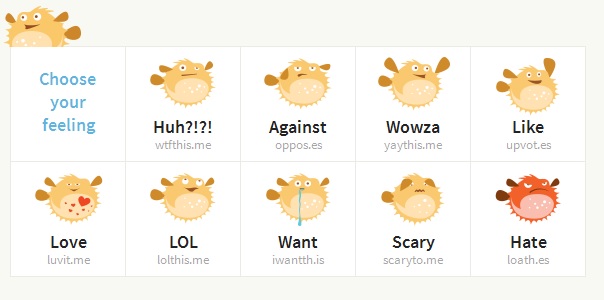 This article, published on Wired last week, makes me beyond excited. At first, I thought “The ‘Mood Graph’: How Our Emotions Are Taking Over the Web” was going to be another one of those “social media is rendering us incapable of human interaction/turning us into unfeeling device-addicted automatons/ruining our lives/etc.” pieces.
Instead, author Evan Selinger (a Fellow at the Institute for Ethics and Emerging Technology) takes a totally different stance. His argument: The written word, whether it appears on a postcard or in a tweet, is already a step removed from spoken communication. Whenever we write, we’re essentially translating our thoughts into the words and phrases available to us. (We do this when we speak, too, of course—but in writing, we usually strive to be more brief and linear than in casual speech.)
So what if digital communication’s latest little embellishments—emoticons, emoji, and the newly available Bitly for Feelings—could actually help us understand each other’s written musings better? Personally, I’ve come to think of these as a kind of punctuation, adding meaning to otherwise ambiguous statements.
Says Selinger, “How many times have you heard, for example, people observe (or console others) that ‘Oh, well, you can never really read tone in email?’”
Yes, forcing users to choose from a drop-down menu of a few dozen grinning and grimacing smileys might limit or simplify the ideas we can express. But wait, doesn’t language do the exact same thing? It’s well-known that there are many emotions for which English has no words.
Selinger explores the social and political implications of confessing our emotions to a blinking status bar. (There’s no doubt a company like Facebook will use its growing “mood data” to its advantage.) This is the first I’ve heard a writer frame emotional (pictorial?) communication this way. But I have a feeling it won’t be the last.
As sharing new aspects of our lives becomes more commonplace, I’ll be interested to see how these add-ons to our language shape and inform the way we communicate.
 MARY GABLE
What do you think?